1) http://esterinbiology.blogspot.ca/2013/12/interesting-simple-animal-phyla.html
http://esterinbiology.blogspot.ca/2014/01/cnidaria.html
http://esterinbiology.blogspot.ca/2013/10/part-1-1-virus-particle-is-nucleic-acid.html
http://esterinbiology.blogspot.ca/2013/10/part-2-1-smallpox-is-somewhat-unique-in.html
Friday, January 24, 2014

Final Question #2
Recap Of My "Most Interesting" Blog Posts.
Interesting Arthropod:

I love this blog post just because the what I researched about was so interesting. Here, I learned about this incredible bug that has a long neck used to fight with others of its kind for a chance to reproduce with the lady. The woman Giraffe- Weevil has incredible strength in her legs and uses that power to fold up a leaf probably 20 times her size, and lays one single egg in it. Truly amazing.
Interesting Simple Animal Phyla:

Here, I learned about the flatworms and how they have cilia that help them sweep the ocean floor for food. I also learned the disturbing fact that they are the predators because they feed off of injured animals and dead animals...eghhh!
Interesting Plant:

This plant has a variety of names, one of which is Dragon Lily. The reason why I chose this plant was because when it blooms, it smells like rotten meat for a few days to attract flies for pollination. Interesting eh?
Celebrity Bug:

I chose a bug that was named after Arnold Schwarzenegger. This bug is very rare and the only reason it's named after the actor/boxer is because of its extremely developed middle femora that resembles Arnord's built physique.
Why Do Goldfishes Turn White in the Dark?

I noticed this question on Yahoo Answers and I immediately searched if it was true or not. It turns out that goldfishes have pigmentations like humans. The best way to explain this is to use suntanning as an example. When you're out in the sun, you tan but if you're inside all day, you lose that color. This is what happens to goldfishes in the dark.
Hammerhead Sharks:

This was the first 'Interesting Blog Post" I did. I wondered why Hammerhead sharks look the way they do. I found out that they use it for vision- they can see above and under them at all times. They also have complex sensory organs in the head to make his sight great. Lastly, he uses his head for pinning pray to the ocean floor and maneuvering his way around currents.
Cnidaria:

In this post I explained feeding, respiration, circulation, exertion, response, movement and reproduction of these interesting species.
While I love all these posts and its hard to chose a favorite, I feel like the post about the Giraffe-Weevil was the most interesting. As soon as I learned about it I went home and showed my parents and little brother, which I managed to wow. It was a post that I researched with ease and excitement. I learned that there are such a big variety of species and some of them can do things that I thought were impossible. Once I finished the BBC youtube video, I was truly amazed at the strong women Giraffe-Weevils and all their hard work for a single egg. I feel like this explains Natural Selection quite well because of the fact that this bug is not only smart, but very complex and creative in the way it makes the cocoons. In addition, these bugs are full of character. The males joust each other with their necks and the woman referees until one of them win to mate. All the woman needs the man for is his sperm and then shes off on her own, using her little hulk like bug legs to make a leaf cocoon for her only offspring. If that isn't character, I don't know what is!
Thursday, January 23, 2014
Final Question #1
Digestion:
Roundworm- does not contain stomach but goes from mouth to pharynx to intestines to rectum to anus.
Earthworm- digestion occurs from mouth to pharynx to esophagus to crop to intestines and to anus.
Grasshopper- mouth to pharynx to esophagus to crop to gizzard then to anus.
Starfish- food goes in mouth to stomach to intestine to anus. The stomach comes out of its mouth and releases digestive juices on its pray so it can then eat/absorb the partially digested pray.
Frog- food goes from mouth to pharynx to esophagus to stomach to small intestine to large intestine to anus.
** digestion path is very similar to humans.
Reproduction:
Roundworm- Have a male and a female. Female goes through internal fertilization.
Earthworm- Hermaphrodites. Go through internal fertilization and form a cocoon at their rear once fertilization occurs.
Grasshopper- Have a male and a female which reproduce internally. Produces about 10-30 offspring which then later mature like their parents.
Starfish- Hermaphrodites. Can produce sexually and asexually. Firstly, they can use their gonads to release its reproductive parts (sperm + egg) into the water. It can also cut off an arm with either the eggs or the sperm, and grow another starfish!!!
Frog- Has a male and a female which reproduce externally. They lay their eggs in the water until they eventually hatch and live on land.
Respiration:
Roundworm- No respiration but releases Carbon Dioxide.
Earthworm- No respiration but breathe through their skin.
Grasshopper- Have something called Spiracles on their sides that connect to the trachea and exchange Oxygen and carbon dioxide. This is especially important because they do not have lungs.
Starfish- Ampulla helps with respiration but they don`t have lungs.
Frog- Contain lungs as well as can breathe through the skin. Respiration system is very similar to humans.
Circulation:
Roundworm- None
Earthworm- contain 3 main blood vessels. Dorsal Blood Vessel (brings blood to the front of the body), Ventral Blood Vessel (takes blood to back of body), and Aortic Arches (pumps blood to Ventral and Dorsal Blood Vessels)
Grasshopper- Contains heart. Blood doesn't flow on its own but rather stays in place.
Starfish- Uses the Water Vascular System through the Madreporite.
Frog- Similar to humans- uses heart to pump blood to other arteries/veins.
Nervous System:
Roundworm- contain Dorsal and Ventral Nerve cord that transmits impulses throughout the body.
Earthworm- Contains Segmental Ganglions, Celebral Ganglion (brain-like) and a Ventral Nerve chord which help it move.
Grasshopper- contains brain, eyes, antenna and the Ventral Nerve Chord which helps it move. The brain isn't very important to the grasshopper, but instead the antenna.
Starfish- Only contains eyespots at the end of each arm. No brain.
Frog- Very similar to humans. Contains a brain which connects to the spinal chord and the rest of the nervous system to help it move and feel things.
We can easily see how in each of these categories, the species get more and more complex. This could easily be an example of Natural selection. With the explanation I gave for each category, you can the the characteristics and the ability for one to survive in the environment. Its obvious that the frog is the strongest of all in many ways. Also, I wonder why the frog is so similar to humans. At one look, you would never guess what goes on in that little body of theirs. There are some similarities between the animals listed above. For example, the all have a mouth and an anus. Also, every single one of these creatures contain a Ventral Nerve Chord in their nervous system. Each of these species are so special in their own way and I'm glad I got to learn about them.
Roundworm- does not contain stomach but goes from mouth to pharynx to intestines to rectum to anus.
Earthworm- digestion occurs from mouth to pharynx to esophagus to crop to intestines and to anus.
Grasshopper- mouth to pharynx to esophagus to crop to gizzard then to anus.
Starfish- food goes in mouth to stomach to intestine to anus. The stomach comes out of its mouth and releases digestive juices on its pray so it can then eat/absorb the partially digested pray.
Frog- food goes from mouth to pharynx to esophagus to stomach to small intestine to large intestine to anus.
** digestion path is very similar to humans.
Reproduction:
Roundworm- Have a male and a female. Female goes through internal fertilization.
Earthworm- Hermaphrodites. Go through internal fertilization and form a cocoon at their rear once fertilization occurs.
Grasshopper- Have a male and a female which reproduce internally. Produces about 10-30 offspring which then later mature like their parents.
Starfish- Hermaphrodites. Can produce sexually and asexually. Firstly, they can use their gonads to release its reproductive parts (sperm + egg) into the water. It can also cut off an arm with either the eggs or the sperm, and grow another starfish!!!
Frog- Has a male and a female which reproduce externally. They lay their eggs in the water until they eventually hatch and live on land.
Respiration:
Roundworm- No respiration but releases Carbon Dioxide.
Earthworm- No respiration but breathe through their skin.
Grasshopper- Have something called Spiracles on their sides that connect to the trachea and exchange Oxygen and carbon dioxide. This is especially important because they do not have lungs.
Starfish- Ampulla helps with respiration but they don`t have lungs.
Frog- Contain lungs as well as can breathe through the skin. Respiration system is very similar to humans.
Circulation:
Roundworm- None
Earthworm- contain 3 main blood vessels. Dorsal Blood Vessel (brings blood to the front of the body), Ventral Blood Vessel (takes blood to back of body), and Aortic Arches (pumps blood to Ventral and Dorsal Blood Vessels)
Grasshopper- Contains heart. Blood doesn't flow on its own but rather stays in place.
Starfish- Uses the Water Vascular System through the Madreporite.
Frog- Similar to humans- uses heart to pump blood to other arteries/veins.
Nervous System:
Roundworm- contain Dorsal and Ventral Nerve cord that transmits impulses throughout the body.
Earthworm- Contains Segmental Ganglions, Celebral Ganglion (brain-like) and a Ventral Nerve chord which help it move.
Grasshopper- contains brain, eyes, antenna and the Ventral Nerve Chord which helps it move. The brain isn't very important to the grasshopper, but instead the antenna.
Starfish- Only contains eyespots at the end of each arm. No brain.
Frog- Very similar to humans. Contains a brain which connects to the spinal chord and the rest of the nervous system to help it move and feel things.
We can easily see how in each of these categories, the species get more and more complex. This could easily be an example of Natural selection. With the explanation I gave for each category, you can the the characteristics and the ability for one to survive in the environment. Its obvious that the frog is the strongest of all in many ways. Also, I wonder why the frog is so similar to humans. At one look, you would never guess what goes on in that little body of theirs. There are some similarities between the animals listed above. For example, the all have a mouth and an anus. Also, every single one of these creatures contain a Ventral Nerve Chord in their nervous system. Each of these species are so special in their own way and I'm glad I got to learn about them.
Finding Nemo Response
After watching "Finding Nemo", I was surprised about how much things I saw differently that from when I was a kid. For one, I understood the jokes 100 times better, but I also noticed and understood a lot about the way the animals behaved. For example, I noticed the flatworm right away and thought about how great they portrayed its beautiful and vibrant colors. I also thought about the motions that it made and remembered that it uses those 'wavy' muscles at it's sides to help it swim and turn. In addition, I noticed the starfish and couldn't help but think about its gonads, stomach and sieve plate. I also love that before, I used to call their skin "the bumpy thing" but not I know that it's called the papula. In addition, I now know that Jellyfish's scientific/proper name is Cnidaria. Even though I've watched the movie several times, I couldn't help but think that the cnidaria could easily prey on Marlin and Dory because they eat anything prom plankton to something twice its size. Overall, my biology class this year has made me realize small things I never would have noticed before.




Rat dissection
Watch out, there are A LOT of pictures coming your way!


Here we determined that it was a female.


This is the skull of the rat.


All our labelled organs. We added the brain to the list as well.


Echinoderm Dissection
Today, we dissected a starfish! Believe it or not, I have always wanted to see what goes on inside them and I was not disappointed in the end. Because I am terrible at using the labeling app, I will just comment on where everything is.


The dot in the middle I'm pointing at is called the Madreporite, where the waste comes out of.

Right in the middle, we have its inverted stomach. We learned that the stomach comes out of the mouth (located under the stomach at the moment) and squirts its digestive juices out on the pray. Fortunately, we got to see this up close. Also, straight through the middle of the arms are something called tube feet.

We got lucky here because it was a clean cut through the middle so we could identify things easier. The ball-like nude things stuck at the top are called the ampulla. The green substance at the bottom is called pyloric caeca. In the far, far corners, closer to its middle area, we have the gonads which are used for reproduction purposes.


Dissecting this starfish was quite interesting because they are much more complex than they seem. Its incredible what important parts they hold in their arms!

CNIDARIA
Feeding: They feed in many ways. From predation, absorbing dissolved organic chemicals, filtering food particles out of the water, and obtaining nutrients from symbiotic algae.
Respiration: They have no respiratory organs but they have a digestive cavity which holds water that regularly need to be changed once it becomes stale. They use their ciliated grooves on their tentacles to pump water out of the digestive cavity without opening its mouth, which controls the water pressure without expelling undigested food.
Circulation: Do not have circulatory system but use a process called Diffusion instead which allows cells to push nutrients thought the body themselves instead of using arteries like us.
Excretion: Cnidaria only have one opening in their bodies which means they poop and eat all in one place...ew. Some waste is actually turned into gas and released with the process I named earlier, Diffusion.
Response: They have a nervous system called Nerve Net System which means that their cells are further spread apart and they respond to touch. So, watch out!
Movement: They have very weak muscles so they tend to move with the water current. If necessary, they push water from their "mushroom tops" so they can propel the direction they want to go.
Reproduction: Can produce sexually and asexually. The male releases the sperm and hopes it swims to reach the female eggs.


Respiration: They have no respiratory organs but they have a digestive cavity which holds water that regularly need to be changed once it becomes stale. They use their ciliated grooves on their tentacles to pump water out of the digestive cavity without opening its mouth, which controls the water pressure without expelling undigested food.
Circulation: Do not have circulatory system but use a process called Diffusion instead which allows cells to push nutrients thought the body themselves instead of using arteries like us.
Excretion: Cnidaria only have one opening in their bodies which means they poop and eat all in one place...ew. Some waste is actually turned into gas and released with the process I named earlier, Diffusion.
Response: They have a nervous system called Nerve Net System which means that their cells are further spread apart and they respond to touch. So, watch out!
Movement: They have very weak muscles so they tend to move with the water current. If necessary, they push water from their "mushroom tops" so they can propel the direction they want to go.
Reproduction: Can produce sexually and asexually. The male releases the sperm and hopes it swims to reach the female eggs.
Tuesday, January 7, 2014
Interesting Arthropod


Here it shows the woman neck vs the male neck size.

Here are the "egg cocoons" made by the mother from leaves.
Thursday, December 12, 2013
Interesting Simple Animal Phyla
PLATYHELMINTHES : FLATWORMS
Pseudoceros pardalis, or the leopard flatworm (in the video) is one of the most colorful and extraordinarily diverse marine flatworms.
I chose to do the flatworms because I am both astonished by their beauty while being a bit grossed out with the fact that they are still classified as worms. I found out that they live in coral reefs, hidden under rocks or rubble. It swims using the edges of its body which are also the layers of muscle. As you can see, it is a very flat creature hence the name flatworm. They have very small hairlike cilia that cover their body to help them glide the ocean floor. They do not have eyes, but they can sense light.The interesting thing is that these flatworms don't really have a predator to watch out for, but are actually predators themselves. They feed off of injured animals, dead animals, bryozoans and soft corals. They can also absorb nutrients through the skin.
Fun Fact: the female leopard flatworm is attracted most to the males with the biggest spots.
Some more pictures of interesting flatworms:


I chose to do the flatworms because I am both astonished by their beauty while being a bit grossed out with the fact that they are still classified as worms. I found out that they live in coral reefs, hidden under rocks or rubble. It swims using the edges of its body which are also the layers of muscle. As you can see, it is a very flat creature hence the name flatworm. They have very small hairlike cilia that cover their body to help them glide the ocean floor. They do not have eyes, but they can sense light.The interesting thing is that these flatworms don't really have a predator to watch out for, but are actually predators themselves. They feed off of injured animals, dead animals, bryozoans and soft corals. They can also absorb nutrients through the skin.
Fun Fact: the female leopard flatworm is attracted most to the males with the biggest spots.
Some more pictures of interesting flatworms:
Friday, December 6, 2013

Arts and crafts
Our arts and crafts project. It started off as an owl on a branch but it gradually turned into a penguin with earmuffs and scarfs.
Thursday, November 28, 2013
Interesting Plants
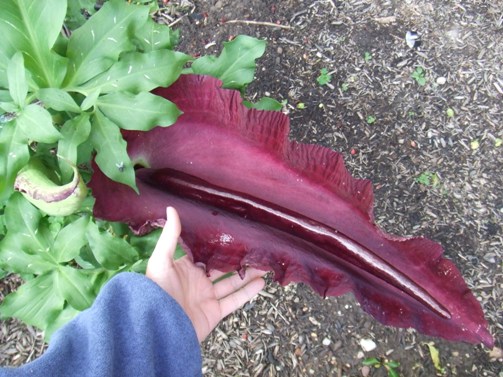
A cool plant I found is called Dracunculus vulgaris (Dragon or Voodoo Lily).
This flower is originally from Greece and goes by various names.Things such as:
Dragon Arum, the Black Arum, the Voodoo Lily, the Snake Lily, the Stink Lily, the Black Dragon, the Black Lily, Dragonwort, and Ragons. The Greek thought it resembled a dragon hiding in the spathe. The plant can be 2 m high. This plant is known for it's striking beauty but it has a nasty smell of rotting meat is designed to attract flies for pollination. Fortunately the smell usually lasts for only one day. It is a poisonous plant that animals do not approach.


Wednesday, November 27, 2013
Pinecone vs acorn
The difference between an acorn and a pine cone is that pine cones are produced from oak while acorns are produced from oak. Also pine cones have multiple seeds while acorns just have one. Another important difference is that acorns are dispersed by animals (either bury them or they eatvthem and grow once they go to the washroom). Pine cones disperse themselves by releasing pollen into the atmosphere. 
Wednesday, November 20, 2013
Moss Compared to Fern Project
Jaime, Nica and myself decided not to do a poster for this assignment but a google doc instead. We found this much easier to do our divided parts in the comfort of our homes without having to meet up somewhere. Hope you like it :)
Wednesday, November 13, 2013
Midterm Evaluation
Biology 11 topics- What I am proud of:
.JPG)


Play Dough Cell blog post
Classification and Taxonomy: For this I chose the big project of creating our own animals and naming them> This showed my creativity as well as my understanding of Taxonomy (names).
.JPG)
Also, I would like to add the blog post of the 5 different animals we had to choose, and then comparing their domain, kingdom, phylum, class, order, family, genus, and species.
For Evolution, The main project I am proud of Is the Evolution Video we made. This might actually be one of my best projects in Biology so far because of all the effort and information me and my partner put into it.
( unfortunately, I don't have a link for this because it failed to upload to YouTube many times)
For the virus section, I am really proud of a research blog I did. It was the Virus Questions as well as Information on Smallpox. I was so genuinely curious about this virus that I continued to research it after.
Finally, for Bacteria and Protists, I chose the quiz that we did. I feel like I tried my best and tried to put in as much information as I could.

Just because this is a general quiz, I'm also going to mention the play dough cell lab as well as our protist microscope lab. I loved making the play dough cell because I'm a hands-on learner, therefore it was an excellent way for me to understand and engrave the names onto my brain. Looking at the protist on the microscope was really interesting. I thought everything looked so cool and beautiful in a weird microscopic way (especially the volvox)


Play Dough Cell blog post
I think that I am a good student. I finish my projects in time and try to engage with the class in my own way. I really do enjoy this class and put a lot of effort into my work and projects. I think that just being in this class has been a powerful learning experience. I am a learner that likes to be on my feet, using my hands and stimulating my brain. Sitting in a classroom copying notes from a Powerpoint everyday doesn't help very much. This class is great because not only are we doing all these activities, but were learning by discussing in class and voicing our opinions. I feel that everything we do in this particular class has so much effect on my learning outcome (in a good way). So as you can see, its really difficult to chose a specific event when the whole experience has been full of learning, but if I had to, I would chose searching up for things we pass by everyday. For example, how slugs mate or why does a goldfish turns white in the dark, or even the fact that people name organisms after celebrities. I also feel like I'm doing very good in this class and learning so much. Because of this, I want to give myself an A or specifically 90-95%. The rest is all up to Ms.Phillips. One thing I definitely don't want to do is push my mark where it shouldn't be but from all the projects and labs, this is what I hope to receive as my midterm report card grade for Biology 11. :)
Subscribe to:
Posts (Atom)