Thursday, January 23, 2014

CNIDARIA

Feeding: They feed in many ways. From predation, absorbing dissolved organic chemicals, filtering food particles out of the water, and obtaining nutrients from symbiotic algae. 

Respiration: They have no respiratory organs but they have a digestive cavity which holds water that regularly need to be changed once it becomes stale. They use their ciliated grooves on their tentacles to pump water out of the digestive cavity without opening its mouth, which controls the water pressure without expelling undigested food.

Circulation: Do not have circulatory system but use a process called Diffusion instead which allows cells to push nutrients thought the body themselves instead of using arteries like us.  

Excretion: Cnidaria only have one opening in their bodies which means they poop and eat all in one place...ew. Some waste is actually turned into gas and released with the process I named earlier, Diffusion. 

Response: They have a nervous system called Nerve Net System which means that their cells are further spread apart and they respond to touch. So, watch out!

Movement: They have very weak muscles so they tend to move with the water current. If necessary, they push water from their "mushroom tops" so they can propel the direction they want to go. 

Reproduction: Can produce sexually and asexually. The male releases the sperm and hopes it swims to reach the female eggs. 

Tuesday, January 7, 2014

Interesting Arthropod

The interesting arthropod I chose is called a Giraffe-Necked Weevil (Trachelophorus giraffa) which is from the island of Madagascar. They were discovered in 2008. The first feature that they have that is incredibly visible, is their long neck. The males, which have necks 3 times longer than the females, use it to fight other males. They have a distinctive red shell covering the wings. They are also herbivores. The women Giraffe Weevils referee the men fighting, and she reproduces with the victor. Once they do the deed, the woman uses her long legs and literally bends a leaf in half. Then she proceeds to roll the leaf and lay a single egg inside of it. Once the egg is appropriately cocooned, she snips the stem of the leaf so the egg drops to the ground where it can then begin to hatch. These interesting guys are generally safe with humans. They are quite rare in the fact that we didn't know they existed until recently.

Here it shows the woman neck vs the male neck size.
Here are the "egg cocoons" made by the mother from leaves.


Thursday, December 12, 2013

Interesting Simple Animal Phyla

PLATYHELMINTHES : FLATWORMS 

Pseudoceros pardalis, or the leopard flatworm (in the video) is one of the most colorful and extraordinarily diverse marine flatworms.

I chose  to do the flatworms because I am both astonished by their beauty while being a bit grossed out with the fact that they are still classified as worms. I found out that they live in coral reefs, hidden under rocks or rubble. It swims using the edges of its body which are also the layers of muscle. As you can see, it is a very flat creature hence the name flatworm. They have very small hairlike cilia that cover their body to help them glide the ocean floor. They do not have eyes, but they can sense light.The interesting thing is that these flatworms don't really have a predator to watch out for, but are actually predators themselves. They feed off of injured animals, dead animals, bryozoans and soft corals. They can also absorb nutrients through the skin. 
Fun Fact: the female leopard flatworm is attracted most to the males with the biggest spots. 
Some more pictures of interesting flatworms:

Friday, December 6, 2013

Gymnospern lab

Arts and crafts

Our arts and crafts project. It started off as an owl on a branch but it gradually turned into a penguin with earmuffs and scarfs.

Thursday, November 28, 2013

Interesting Plants

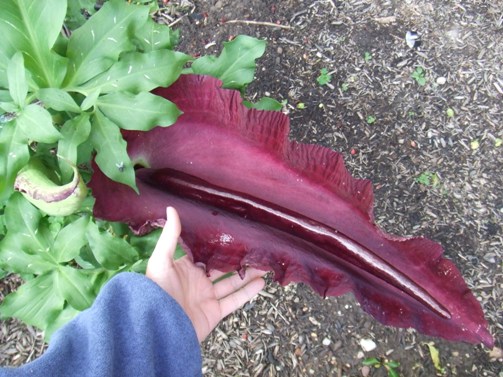
A cool plant I found is called Dracunculus vulgaris (Dragon or Voodoo Lily).

This flower is originally from Greece and goes by various names.Things such as: 
Dragon Arum, the Black Arum, the Voodoo Lily, the Snake Lily, the Stink Lily, the Black Dragon, the Black LilyDragonwort, and Ragons. The Greek thought it resembled a dragon hiding in the spathe. The plant can be 2 m high. This plant is known for it's striking beauty but it has a nasty smell of rotting meat is designed to attract flies for pollination. Fortunately the smell usually lasts for only one day. It is a poisonous plant that animals do not approach. 


Wednesday, November 27, 2013

Pinecone vs acorn

The difference between an acorn and a pine cone is that pine cones are produced from oak while acorns are produced from oak. Also pine cones have multiple seeds while acorns just have one. Another important difference is that acorns are dispersed by animals (either bury them or they eatvthem and grow once they go to the washroom). Pine cones disperse themselves by releasing pollen into the atmosphere.